
Watering
How you water matters as much as how much — and a few simple choices do most of the work.
The basic idea
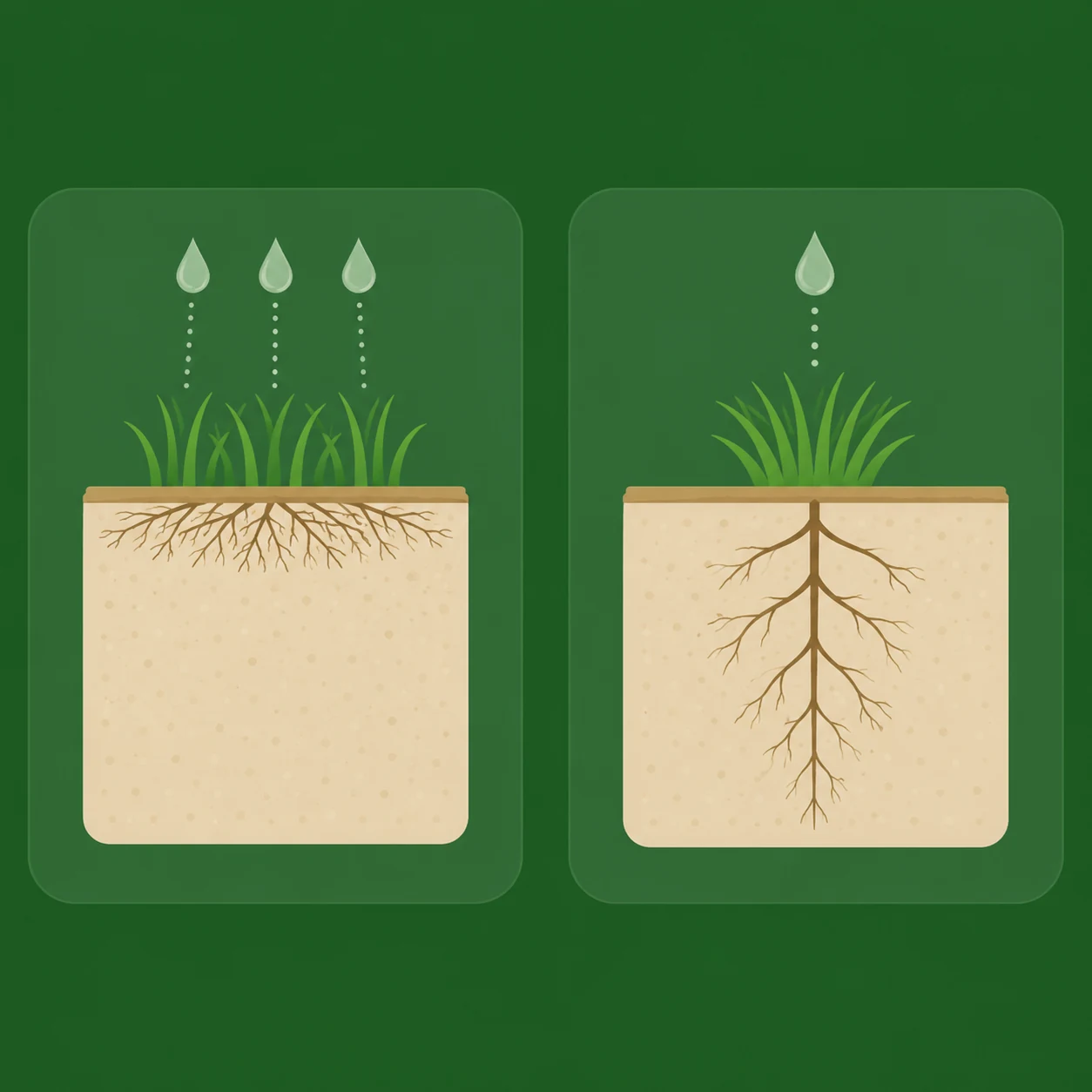
Deep and infrequent.
The usual target is a soak to about 6 inches, then a wait until the lawn looks thirsty before watering again.[AgriLife Today] Deep, occasional soaks pull roots down toward the water; light daily sprinkles keep them shallow.
The numbers
How much, and when.
The numbers below are a ballpark.[TAMU Soil & Crop, Texas ET Network] The real sweet spot moves with sun, shade, slope, and soil — a sunny slope drinks far more than a flat, shady corner, and parts of one lawn can differ.
1–2 in.
of water per week when it's dry. Rainfall counts toward it.
1–2×
a week is plenty. More often than that keeps roots shallow.
Early AM
Low evaporation, and the lawn dries out through the day.
Grass type shifts the dial too: St. Augustine leans to the higher end, while Bermuda and Zoysia shrug off drought and get by on less.
Early morning has a bonus: the blades dry as the day warms. Late-evening watering leaves them wet overnight — the prolonged leaf wetness lawn disease favors.[AgriLife Today]
Let the lawn tell you
How a lawn shows it's thirsty.
The footprint test
On a dry lawn, footprints stay pressed in and the blades are slow to spring back; the color dulls to a blue-gray green.[TAMU Soil & Crop]
How deep it soaked
A screwdriver shows how deep it soaked: in well-watered soil it pushes to about 6 inches easily. If it stalls short, the water didn't get down far.[TAMU Soil & Crop]
When water pools or runs off
The water isn't soaking in — and the cause can vary: going on faster than the soil absorbs (heavy clay, compaction, a slope), a zone running at low pressure, a leaking head or line, or ground that's already saturated.
Brown in a drought? Often just dormant
A healthy lawn can turn tan and go dormant in a severe drought — a survival mode, not death. It greens back up once steady water returns; a dormant lawn isn't asking to be soaked.[AgriLife Today]
One local note: many cities here cap watering days in summer, and the rules vary town to town — a schedule that's fine in one place may not be allowed in the next.
When did your lawn last get a deep, proper soak?
Contact usSources
- 1.Grubbs, B. "Water-Wise Tips for Turfgrass offered by AgriLife Extension." Texas A&M AgriLife Today, July 18, 2018. Link
- 2.Grubbs, B. "Turfgrass tips to make a lawn the envy of the neighborhood." Texas A&M Dept. of Soil & Crop Sciences, April 22, 2018. Link
- 3.Tool — Texas ET Network: local evapotranspiration and lawn watering-need estimates. Texas A&M AgriLife. Link
General guidance drawn from Texas A&M AgriLife Extension — a starting point, not a prescription. Every lawn, soil, and sprinkler setup is a little different.